Engineering Internship in Spain vs the UK: What’s Actually Different (2026)
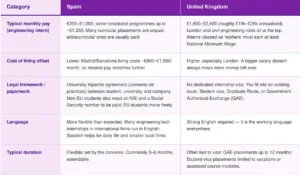
A UK engineering internship pays far more in cash, typically £1,600–£2,400 per month, versus €300–€1,000 per month in Spain, but the UK has no dedicated ‘internship visa’ and stricter immigration rules, while Spain runs on a flexible university agreement (the convenio de prácticas) that makes the paperwork easier, especially for EU students. The UK wins on pay and post-study work rights; Spain wins on lower cost of living, easier entry, and more English-friendly flexibility than most students expect.
Below is the side-by-side, then the detail that actually matters when you choose.
Spain vs UK at a glance
Pay: the biggest and most obvious gap
This is where the two countries genuinely diverge. In the UK, an engineering intern typically earns between £1,600 and £2,400 a month, with London and disciplines like civil engineering at the upper end. In Spain, a paid engineering internship usually lands between €300 and €1,000 a month, with a handful of structured corporate programmes reaching around €1,250.
But raw pay is misleading on its own. London is one of the most expensive cities in Europe, while living costs in Madrid or Barcelona run roughly €800–€1,500 a month. So a smaller Spanish stipend often leaves you in a similar real-world position — and Spain’s climate, pace, and lower rent are a big part of why students still choose it.
Paperwork and visas: where Spain is actually simpler
Spain’s system is built around the convenio de prácticas — a three-way agreement signed by your university, the company, and you. It keeps the process predictable. Non-EU students additionally need an NIE (foreigner ID number) and a Social Security number before they can be paid, and EU students move essentially freely.
The UK is the opposite kind of complexity: there is no internship-specific visa. You have to slot into one of three routes:
|
Route |
What it allows |
Watch out for |
|
Student visa |
Internships during your studies — up to 20 hours/week in term time, full-time in official vacations, or as an assessed part of your course. |
Self-employment and permanent full-time roles are banned; universities report breaches to the Home Office. |
|
Graduate Route |
Any work at any level for 2 years after a UK degree, no employer sponsorship needed. |
Reducing to 18 months for undergrad/master’s graduates from 1 January 2027. |
|
Government Authorised Exchange (GAE) |
Structured internships up to 12 months, sponsored by an authorised scheme operator. |
The host company usually isn’t the sponsor; you need a Certificate of Sponsorship through an approved scheme. |
The practical takeaway: if you’re already studying in the UK, an internship is straightforward within your visa limits. If you’re coming from abroad specifically to intern, the UK is heavier on immigration admin than Spain.
Language: less of a barrier in Spain than people assume
A common myth is that you need fluent Spanish to intern in Spain. For engineering and tech roles at international companies, the working language is frequently English, and many listings only ask for English. Spanish becomes important for daily life and for smaller local firms but it’s rarely a hard gate for a technical internship. In the UK, strong English is non-negotiable across the board.
After the internship: the UK’s quiet advantage
If your goal is to stay and build a career in the country, the UK’s Graduate Route is one of the cleanest post-study pathways in Europe: two years of unrestricted work with no sponsor required. Spain doesn’t have a single equivalent, though EU students benefit from free movement, and non-EU graduates can convert to a work contract with more paperwork.
So which should you choose?
Choose the UK if you want the highest pay and a clear runway to stay and work afterwards, and you’re comfortable navigating stricter immigration rules. Choose Spain if you want lower living costs, an easier and more flexible entry process, and an English-friendly engineering scene without needing a dedicated visa.
At OptiApply, across our engineering placements, we’ve seen 50 % of engineering interns placed in paid roles.
FAQ
-
Do I need to speak Spanish to get an engineering internship in Spain?
Not usually. Many engineering and tech internships at international companies in Spain are conducted in English, and several listings only require English. Spanish is helpful for daily life and for smaller local firms, but it’s rarely a strict requirement for a technical role. -
Can a non-UK student legally do a paid engineering internship in the UK?
Yes, but only through a recognised route, because there is no dedicated UK internship visa. Options include the Student visa (with hour limits during term time), the Graduate Route (two years of unrestricted work after a UK degree, no sponsorship), or the Government Authorised Exchange visa (structured internships up to 12 months via an authorised scheme operator). -
Which pays more, an engineering internship in Spain or the UK?
The UK pays significantly more in cash, typically £1,600–£2,400 per month, versus €300–€1,000 per month in Spain. However, the UK’s higher cost of living, especially in London, narrows the real-world gap, since Spanish living costs are considerably lower.
Related Articles
-
How to Land a Marketing Internship in London
Avoid these common pitfalls that prevent students from getting past the screening stage.Jul 25, 20262 min read -
How to Land a Marketing Internship in Paris
Avoid these common pitfalls that prevent students from getting past the screening stage.Jul 10, 20265 min read -
Jun 25, 20262 min read